H 4 In A Row Mac OS
The sqlite3 module is not built with loadable extension support by default, because some platforms (notably Mac OS X) have SQLite libraries which are compiled without this feature. To get loadable extension support, you must pass -enable-loadable-sqlite-extensions to configure. As for the Chrome OS, the share stood at 11.5% for Q3 and then 14.4% share for Q4. When it comes to Microsoft Windows, the share stood at 87.5% in Q1, 81.7% in Q2, 78.9% in Q3 and 76.7% in Q4, showing a clear drop in market share in every quarter of 2020. “Three quarters in a row of Chrome OS above macOS makes a trend.
- H 4 In A Row Mac Os Download
- H 4 In A Row Mac Os 11
- 4 In A Row Online
- H 4 In A Row Mac Os X
- H 4 In A Row Mac Os Catalina
- Windows
Jump to: Frequently used shortcuts, Work in windows and dialogs, Move and scroll in a sheet or workbook, Enter data on a sheet, Work in cells or the Formula bar, Format and edit data, Select cells, columns, or rows, Work with a selection, Use charts, Sort, filter, and use PivotTable reports, Outline data, The following table provides the function key shortcuts for Excel 2016 for Mac*…
⌘+V or Ctrl+V | Paste |
⌘+C or Ctrl+C | Copy |
Delete | Clear |
⌘+S or Ctrl+S | Save |
⌘+Z or Ctrl+Z | Undo |
⌘+Y or Ctrl+Y | Redo |
⌘+X or Ctrl+X | Cut |
⌘+B or Ctrl+B | Bold |
⌘+P or Ctrl+P | |
⌥+F11 | Open Visual Basic |
⌘+D or Ctrl+D | Fill Down |
⌘+R or Ctrl+R | Fill Right |
Ctrl+Shift+= | Insert cells |
⌘+- or Ctrl+- (hyphen) | Delete cells |
⌘+= or F9 | Calculate all open workbooks |
⌘+W or Ctrl+W | Close window |
⌘+Q | Quit Excel |
Ctrl+G or F5 | Display the Go To dialog box |
⌘+1 or Ctrl+1 | Display the Format Cells dialog box |
Ctrl+H or ⌘+Shift+H | Display the Replace dialog box |
⌘+Ctrl+V or Ctrl+⌥+V | Paste Special |
⌘+U | Underline |
⌘+I or Ctrl+I | Italic |
⌘+N or Ctrl+N | New blank workbook |
⌘+Shift+P | New workbook from template |
⌘+Shift+S or F12 | Display the Save As dialog box |
F1 or ⌘+/ | Display the Help window |
⌘+A or ⌘+Shift+Space | Select All |
⌘+Shift+F or Ctrl+Shift+L | Add or remove a filter |
⌘+⌥+R or Ctrl+O | Minimize or maximize the ribbon tabs |
⌘+O | Display the Open dialog box |
F7 | Check spelling |
Shift+F7 | Open the thesaurus |
Shift+F3 | Display the Formula Builder |
⌘+F3 | Open the Define Name dialog box |
⌘+Shift+F3 | Open the Create names dialog box |
Shift+F11 | Insert a new sheet * |
⌘+P or Ctrl+P | |
⌘+P or Ctrl+P | Print preview |
⌘+⌥+R | Expand or minimize the ribbon |
⌘+Ctrl+F | Switch to full screen view |
⌘+Tab | Switch to the next application |
⌘+Shift+Tab | Switch to the previous application |
⌘+W | Close the active workbook window |
⌘+Shift+3 | Copy the image of the screen and save it to a Screen Shot file on your desktop. |
Ctrl+F9 | Minimize the active window |
Ctrl+F10 or ⌘+F10 | Maximize or restore the active window |
⌘+H | Hide Excel. |
Tab | Move to the next box, ⌥, control, or command |
Shift+Tab | Move to the previous box, ⌥, control, or command |
Esc | Exit a dialog or cancel an action |
Enter | Perform the action assigned to the default command button (the button with the bold outline, often the OK button) |
Esc | Cancel the command and close |
Arrow Keys | Move one cell up, down, left, or right |
⌘+Arrow Key | Move to the edge of the current data region |
Home | Move to the beginning of the row |
Ctrl+Home | Move to the beginning of the sheet |
Ctrl+End | Move to the last cell in use on the sheet |
Page Down | Move down one screen |
Page Up | Move up one screen |
⌥+Page Down | Move one screen to the right |
⌥+Page Up | Move one screen to the left |
Ctrl+Page Down or ⌥+Arrow Right | Move to the next sheet in the workbook |
Ctrl+Page Down or ⌥+Arrow Left | Move to the previous sheet in the workbook |
Ctrl+Delete | Scroll to display the active cell |
Ctrl+G | Display the Go To dialog box |
Ctrl+F or Shift+F5 | Display the Find dialog box |
⌘+F | Access search (when in a cell or when a cell is selected) |
Tab | Move between unlocked cells on a protected sheet |
⌘+` (grave accent) | Move to next workbook |
F2 | Edit the selected cell |
Enter | Complete a cell entry and move forward in the selection |
Ctrl+⌥+Enter | Start a new line in the same cell |
⌘+Return or Ctrl+Enter | Fill the selected cell range with the text that you type |
Shift+Enter | Complete a cell entry and move up in the selection |
Tab | Complete a cell entry and move to the right in the selection |
Shift+Tab | Complete a cell entry and move to the left in the selection |
Esc | Cancel a cell entry |
Delete | Delete the character to the left of the insertion point, or delete the selection |
On a MacBook, pressFn+Delete | Note: Some smaller keyboards do not have this key |
Arrow Keys | Move one character up, down, left, or right |
Home | Move to the beginning of the line |
Shift+F2 | Insert a comment |
Shift+F2 | Open and edit a cell comment |
Ctrl+D or ⌘+D | Fill down |
Ctrl+R or ⌘+R | Fill to the right |
Ctrl+L | Define a name |
F2 | Edit the selected cell |
Delete | Edit the active cell and then clear it, or delete the preceding character in the active cell as you edit the cell contents |
Enter | Complete a cell entry |
⌘+Shift+Return or Ctrl+Shift+Enter | Enter a formula as an array formula |
Esc | Cancel an entry in the cell or formula bar |
Ctrl+A | Display the Formula Builder after you type a valid function name in a formula |
⌘+K or Ctrl+K | Insert a hyperlink |
Ctrl+U | Edit the active cell and position the insertion point at the end of the line |
Shift+F3 | Open the Formula Builder |
Shift+F9 | Calculate the active sheet |
Shift+F10 | Display a contextual menu |
= | Start a formula |
⌘+T or F4 | Toggle the formula reference style between absolute, relative, and mixed |
⌘+Shift+T | Insert the AutoSum formula |
Ctrl+; (semicolon) | Enter the date |
⌘+; (semicolon) | Enter the time |
Ctrl+Shift+' (inchmark) | Copy the value from the cell above the active cell into the cell or the formula bar |
Ctrl+` (grave accent) | Alternate between displaying cell values and displaying cell formulas |
Ctrl+' (apostrophe)) | Copy a formula from the cell above the active cell into the cell or the formula bar |
Ctrl+⌥+Arrow Down | Display the AutoComplete list |
Ctrl+L | Define a name |
Ctrl+⌥+⌘+L | Open the Smart Lookup pane |
F2 | Edit the selected cell |
⌘+T or Ctrl+T | Create a table |
⌘+⌥+Return or Ctrl+⌥+Enter | Insert a line break in a cell |
Ctrl+Space or ⌘+Space | Insert special characters like symbols, including emoji |
⌘+Shift+> | Increase font size |
⌘+Shift+< | Decrease font size |
⌘+E | Align center |
⌘+L | Align left |
⌘+Shift+L | Display the Modify Cell Style dialog box |
⌘+1 | Display the Format Cells dialog box |
Ctrl+Shift+~ | Apply the general number format |
Ctrl+Shift+$ | Apply the currency format with two decimal places (negative numbers appear in red with parentheses) |
Ctrl+Shift+% | Apply the percentage format with no decimal places |
Ctrl+Shift+^ | Apply the exponential number format with two decimal places |
Ctrl+Shift+# | Apply the date format with the day, month, and year |
Ctrl+Shift+@ | Apply the time format with the hour and minute, and indicate AM or PM |
Ctrl+Shift+! | Apply the number format with two decimal places, thousands separator, and minus sign (-) for negative values |
⌘+⌥+0 | Apply the outline border around the selected cells |
⌘+⌥+Arrow Right | Add an outline border to the right of the selection |
⌘+⌥+Arrow Left | Add an outline border to the left of the selection |
⌘+⌥+Arrow Up | Add an outline border to the top of the selection |
⌘+⌥+Arrow Down | Add an outline border to the bottom of the selection |
⌘+⌥+- (hyphen) | Remove outline borders |
⌘+B | Apply or remove bold formatting |
⌘+I | Apply or remove italic formatting |
⌘+U | Apply or remove underscoring |
⌘+Shift+X | Apply or remove strikethrough formatting |
⌘+) or Ctrl+) | Hide a column |
⌘+Shift+) or Ctrl+Shift+) | Unhide a column |
⌘+( or Ctrl+( | Hide a row |
⌘+Shift+( or Ctrl+Shift+( | Unhide a row |
Ctrl+U | Edit the active cell |
Esc | Cancel an entry in the cell or the formula bar |
Delete | Edit the active cell and then clear it, or delete the preceding character in the active cell as you edit the cell contents |
⌘+V | Paste text into the active cell |
Enter | Complete a cell entry |
⌘+Return or Ctrl+Enter | Give selected cells the current cell's entry |
⌘+Shift+Return or Ctrl+Shift+Enter | Enter a formula as an array formula |
Ctrl+A | Display the Formula Builder after you type a valid function name in a formula |
Shift+Arrow Key | Extend the selection by one cell |
⌘+Shift+Arrow Key | Extend the selection to the last nonblank cell in the same column or row as the active cell |
Shift+Home | Extend the selection to the beginning of the row |
Ctrl+Shift+Home | Extend the selection to the beginning of the sheet |
Ctrl+Shift+End | Extend the selection to the last cell used on the sheet (lower-right corner) |
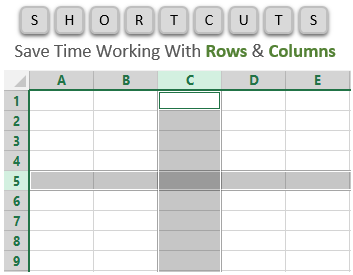
Ctrl+Space | Select the entire column |
Shift+Space | Select the entire row |
⌘+A | Select the entire sheet |
⌘+Shift+* (asterisk) | Select only visible cells |
Shift+Delete | Select only the active cell when multiple cells are selected |
Shift+Page Down | Extend the selection down one screen |
Shift+Page Up | Extend the selection up one screen |
Ctrl+6 | Alternate between hiding objects, displaying objects, and displaying placeholders for objects |
F8 | Turn on the capability to extend a selection by using the arrow keys |
Shift+F8 | Add another range of cells to the selection |
Ctrl+/ | Select the current array, which is the array that the active cell belongs to. |
Ctrl+ | Select cells in a row that don't match the value in the active cell in that row. You must select the row starting with the active cell. |
Ctrl+Shift+[ | Select only cells that are directly referred to by formulas in the selection |
Ctrl+Shift+{ | Select all cells that are directly or indirectly referred to by formulas in the selection |
Ctrl+] | Select only cells with formulas that refer directly to the active cell |
Ctrl+Shift+} | Select all cells with formulas that refer directly or indirectly to the active cell |
⌘+C or Ctrl+C | Copy |
⌘+V or Ctrl+V | Paste |
⌘+X or Ctrl+X | Cut |
Delete | Clear |
Ctrl+- (hyphen) | Delete the selection |
⌘+Z | Undo the last action |
⌘+) or Ctrl+) | Hide a column |
⌘+Shift+) or Ctrl+Shift+) | Unhide a column |
⌘+( or Ctrl+( | Hide a row |
⌘+Shift+( or Ctrl+Shift+( | Unhide a row |
Enter | Move from top to bottom within the selection (down)* |
Shift+Enter | Move from bottom to top within the selection (up)* |
Tab | Move from left to right within the selection, or move down one cell if only one column is selected |
Shift+Tab | Move from right to left within the selection, or move down one cell if only one column is selected |
Ctrl+. (period) | Move clockwise to the next corner of the selection |
⌘+Shift+K or ⌥+Arrow Right | Group selected cells |
⌘+Shift+J or ⌥+Arrow Left | Ungroup selected cells |
F11 | Insert a new chart sheet. |
ArrowKeys | Cycle through chart object selection |
⌘+Shift+R | Open the Sort dialog box |
⌘+Shift+F or Ctrl+Shift+L | Add or remove a filter |
⌥+Arrow Down | Display the Filter list or PivotTable page field pop-up menu for the selected cell |
Ctrl+8 | Display or hide outline symbols |
Ctrl+9 | Hide selected rows |
Ctrl+Shift+( (opening parenthesis) | Unhide selected rows |
Ctrl+0 (zero) | Hide selected columns |
Ctrl+Shift+) (closing parenthesis) | Unhide selected columns |
H 4 In A Row Mac Os Download
12. The following table provides the function key shortcuts for Excel 2016 for Mac*
F1 | Display the Help window |
F2 | Edit the selected cell |
Shift+F2 | Insert or edit a cell comment |
⌥+F2 | Open the Save dialog |
Shift+F3 | Open the Formula Builder |
⌘+F3 | Open the Define Name dialog |
⌘+F4 | Close |
F5 | Display the Go To dialog |
Shift+F5 | Display the Find dialog |
Ctrl+F5 | Move to the Search Sheet dialog |
F7 | Check spelling |
Shift+F7 or Ctrl+⌥+⌘+R | Open the thesaurus |
F8 | Extend the selection |
Shift+F8 | Add to the selection |
⌥+F8 | Display the Macro dialog |
F9 | Calculate all open workbooks |
Shift+F9 | Calculate the active sheet |
Ctrl+F9 | Minimize the active window |
Shift+F10 | Display a contextual menu, or 'right click' menu |
Ctrl+F10 or ⌘+F10 | Maximize or restore the active window |
F11 | Insert a new chart sheet* |
Shift+F11 | Insert a new sheet* |
⌘+F11 | Insert an Excel 4.0 macro sheet |
⌥+F11 | Open Visual Basic |
F12 | Display the Save As dialog |
⌘+F12 | Display the Open dialog |
Created by Peherte on 5/17/2017. Last updated by admin on 2/7/2021
5 Comments for 'Excel '
Comment #5 by _JR_ Feb 7, 2021 at 04:19 am Reply
Hi, yes there is a 'next workbook' shortcut, it's [⌘]+` (grave accent). I just added it to the list.
Comment #4 by _JR_ Feb 7, 2021 at 04:19 am Reply
Hi, yes there is a 'next workbook' shortcut, it's [⌘]+` (grave accent). I just added it to the list.
Comment #3 by Don Jan 8, 2020 at 11:38 am Reply
For Excel 2016 for the Mac: Under the new Mac OS (Catalina) toggling absolute and relative references is now Command-T, not F4. And you need to put your cursor in the formula line; you can't simply select the cell.
Comment #2 by JohnDohe Dec 11, 2018 at 10:12 am Reply
H 4 In A Row Mac Os 11
Re: Excel 2016 for Mac What is the keyboard shortcut to switch between two (or more) open workbooks? I am NOT asking about workSHEETS. I AM referring to workBOOKS. THE FOLLOWING DO NOT WORK TO SWITCH BETWEEN 2 (OR MORE) OPEN 'EXCEL 2016 FOR MAC' WorkBOOKS: Cmd+PageUp/PageDown Cmd+Tab Cmd+ArrowLeft/ArrowRight *** CTRL+PageUp/PageDown CTRL+Tab CTRL+ArrowLeft/ArrowRight *** Option+PageUp/PageDown Option+Tab Option+ArrowLeft/ArrowRight *** Anyone have a keyboard shortcut that works to switch between two (2) or more 'Excel 2016 for Mac' WorkBOOKS? Thanks!
Reply #1 Susana Oct 29, 2020 at 10:55 am
In a PC you can use Alt+Tab to move between all programs open, including several Excel books. I don't know if it works for Mac, sorry
Comment #1 by Mayur Patil Aug 11, 2017 at 01:06 am Reply
Dear Sir, Thank you so much for your helpful guidance. Very useful knowledge.
To use a keyboard shortcut, press and hold one or more modifier keys and then press the last key of the shortcut. For example, to use Command-C (copy), press and hold the Command key, then the C key, then release both keys. Mac menus and keyboards often use symbols for certain keys, including modifier keys:
On keyboards made for Windows PCs, use the Alt key instead of Option, and the Windows logo key instead of Command.
Some keys on some Apple keyboards have special symbols and functions, such as for display brightness , keyboard brightness , Mission Control, and more. If these functions aren't available on your keyboard, you might be able to reproduce some of them by creating your own keyboard shortcuts. To use these keys as F1, F2, F3, or other standard function keys, combine them with the Fn key.
Cut, copy, paste, and other common shortcuts
- Command-X: Cut the selected item and copy it to the Clipboard.
- Command-C: Copy the selected item to the Clipboard. This also works for files in the Finder.
- Command-V: Paste the contents of the Clipboard into the current document or app. This also works for files in the Finder.
- Command-Z: Undo the previous command. You can then press Shift-Command-Z to Redo, reversing the undo command. In some apps, you can undo and redo multiple commands.
- Command-A: Select All items.
- Command-F: Find items in a document or open a Find window.
- Command-G: Find Again: Find the next occurrence of the item previously found. To find the previous occurrence, press Shift-Command-G.
- Command-H: Hide the windows of the front app. To view the front app but hide all other apps, press Option-Command-H.
- Command-M: Minimize the front window to the Dock. To minimize all windows of the front app, press Option-Command-M.
- Command-O: Open the selected item, or open a dialog to select a file to open.
- Command-P: Print the current document.
- Command-S: Save the current document.
- Command-T: Open a new tab.
- Command-W: Close the front window. To close all windows of the app, press Option-Command-W.
- Option-Command-Esc: Force quit an app.
- Command–Space bar: Show or hide the Spotlight search field. To perform a Spotlight search from a Finder window, press Command–Option–Space bar. (If you use multiple input sources to type in different languages, these shortcuts change input sources instead of showing Spotlight. Learn how to change a conflicting keyboard shortcut.)
- Control–Command–Space bar: Show the Character Viewer, from which you can choose emoji and other symbols.
- Control-Command-F: Use the app in full screen, if supported by the app.
- Space bar: Use Quick Look to preview the selected item.
- Command-Tab: Switch to the next most recently used app among your open apps.
- Shift-Command-5: In macOS Mojave or later, take a screenshot or make a screen recording. Or use Shift-Command-3 or Shift-Command-4 for screenshots. Learn more about screenshots.
- Shift-Command-N: Create a new folder in the Finder.
- Command-Comma (,): Open preferences for the front app.
Sleep, log out, and shut down shortcuts
4 In A Row Online
You might need to press and hold some of these shortcuts for slightly longer than other shortcuts. This helps you to avoid using them unintentionally.
- Power button: Press to turn on your Mac or wake it from sleep. Press and hold for 1.5 seconds to put your Mac to sleep.* Continue holding to force your Mac to turn off.
- Option–Command–Power button* or Option–Command–Media Eject : Put your Mac to sleep.
- Control–Shift–Power button* or Control–Shift–Media Eject : Put your displays to sleep.
- Control–Power button* or Control–Media Eject : Display a dialog asking whether you want to restart, sleep, or shut down.
- Control–Command–Power button:* Force your Mac to restart, without prompting to save any open and unsaved documents.
- Control–Command–Media Eject : Quit all apps, then restart your Mac. If any open documents have unsaved changes, you will be asked whether you want to save them.
- Control–Option–Command–Power button* or Control–Option–Command–Media Eject : Quit all apps, then shut down your Mac. If any open documents have unsaved changes, you will be asked whether you want to save them.
- Control-Command-Q: Immediately lock your screen.
- Shift-Command-Q: Log out of your macOS user account. You will be asked to confirm. To log out immediately without confirming, press Option-Shift-Command-Q.
* Does not apply to the Touch ID sensor.
Finder and system shortcuts
- Command-D: Duplicate the selected files.
- Command-E: Eject the selected disk or volume.
- Command-F: Start a Spotlight search in the Finder window.
- Command-I: Show the Get Info window for a selected file.
- Command-R: (1) When an alias is selected in the Finder: show the original file for the selected alias. (2) In some apps, such as Calendar or Safari, refresh or reload the page. (3) In Software Update preferences, check for software updates again.
- Shift-Command-C: Open the Computer window.
- Shift-Command-D: Open the desktop folder.
- Shift-Command-F: Open the Recents window, showing all of the files you viewed or changed recently.
- Shift-Command-G: Open a Go to Folder window.
- Shift-Command-H: Open the Home folder of the current macOS user account.
- Shift-Command-I: Open iCloud Drive.
- Shift-Command-K: Open the Network window.
- Option-Command-L: Open the Downloads folder.
- Shift-Command-N: Create a new folder.
- Shift-Command-O: Open the Documents folder.
- Shift-Command-P: Show or hide the Preview pane in Finder windows.
- Shift-Command-R: Open the AirDrop window.
- Shift-Command-T: Show or hide the tab bar in Finder windows.
- Control-Shift-Command-T: Add selected Finder item to the Dock (OS X Mavericks or later)
- Shift-Command-U: Open the Utilities folder.
- Option-Command-D: Show or hide the Dock.
- Control-Command-T: Add the selected item to the sidebar (OS X Mavericks or later).
- Option-Command-P: Hide or show the path bar in Finder windows.
- Option-Command-S: Hide or show the Sidebar in Finder windows.
- Command–Slash (/): Hide or show the status bar in Finder windows.
- Command-J: Show View Options.
- Command-K: Open the Connect to Server window.
- Control-Command-A: Make an alias of the selected item.
- Command-N: Open a new Finder window.
- Option-Command-N: Create a new Smart Folder.
- Command-T: Show or hide the tab bar when a single tab is open in the current Finder window.
- Option-Command-T: Show or hide the toolbar when a single tab is open in the current Finder window.
- Option-Command-V: Move the files in the Clipboard from their original location to the current location.
- Command-Y: Use Quick Look to preview the selected files.
- Option-Command-Y: View a Quick Look slideshow of the selected files.
- Command-1: View the items in the Finder window as icons.
- Command-2: View the items in a Finder window as a list.
- Command-3: View the items in a Finder window in columns.
- Command-4: View the items in a Finder window in a gallery.
- Command–Left Bracket ([): Go to the previous folder.
- Command–Right Bracket (]): Go to the next folder.
- Command–Up Arrow: Open the folder that contains the current folder.
- Command–Control–Up Arrow: Open the folder that contains the current folder in a new window.
- Command–Down Arrow: Open the selected item.
- Right Arrow: Open the selected folder. This works only when in list view.
- Left Arrow: Close the selected folder. This works only when in list view.
- Command-Delete: Move the selected item to the Trash.
- Shift-Command-Delete: Empty the Trash.
- Option-Shift-Command-Delete: Empty the Trash without confirmation dialog.
- Command–Brightness Down: Turn video mirroring on or off when your Mac is connected to more than one display.
- Option–Brightness Up: Open Displays preferences. This works with either Brightness key.
- Control–Brightness Up or Control–Brightness Down: Change the brightness of your external display, if supported by your display.
- Option–Shift–Brightness Up or Option–Shift–Brightness Down: Adjust the display brightness in smaller steps. Add the Control key to this shortcut to make the adjustment on your external display, if supported by your display.
- Option–Mission Control: Open Mission Control preferences.
- Command–Mission Control: Show the desktop.
- Control–Down Arrow: Show all windows of the front app.
- Option–Volume Up: Open Sound preferences. This works with any of the volume keys.
- Option–Shift–Volume Up or Option–Shift–Volume Down: Adjust the sound volume in smaller steps.
- Option–Keyboard Brightness Up: Open Keyboard preferences. This works with either Keyboard Brightness key.
- Option–Shift–Keyboard Brightness Up or Option–Shift–Keyboard Brightness Down: Adjust the keyboard brightness in smaller steps.
- Option key while double-clicking: Open the item in a separate window, then close the original window.
- Command key while double-clicking: Open a folder in a separate tab or window.
- Command key while dragging to another volume: Move the dragged item to the other volume, instead of copying it.
- Option key while dragging: Copy the dragged item. The pointer changes while you drag the item.
- Option-Command while dragging: Make an alias of the dragged item. The pointer changes while you drag the item.
- Option-click a disclosure triangle: Open all folders within the selected folder. This works only when in list view.
- Command-click a window title: See the folders that contain the current folder.
- Learn how to use Command or Shift to select multiple items in the Finder.
- Click the Go menu in the Finder menu bar to see shortcuts for opening many commonly used folders, such as Applications, Documents, Downloads, Utilities, and iCloud Drive.
Document shortcuts
The behavior of these shortcuts may vary with the app you're using.
H 4 In A Row Mac Os X
- Command-B: Boldface the selected text, or turn boldfacing on or off.
- Command-I: Italicize the selected text, or turn italics on or off.
- Command-K: Add a web link.
- Command-U: Underline the selected text, or turn underlining on or off.
- Command-T: Show or hide the Fonts window.
- Command-D: Select the Desktop folder from within an Open dialog or Save dialog.
- Control-Command-D: Show or hide the definition of the selected word.
- Shift-Command-Colon (:): Display the Spelling and Grammar window.
- Command-Semicolon (;): Find misspelled words in the document.
- Option-Delete: Delete the word to the left of the insertion point.
- Control-H: Delete the character to the left of the insertion point. Or use Delete.
- Control-D: Delete the character to the right of the insertion point. Or use Fn-Delete.
- Fn-Delete: Forward delete on keyboards that don't have a Forward Delete key. Or use Control-D.
- Control-K: Delete the text between the insertion point and the end of the line or paragraph.
- Fn–Up Arrow: Page Up: Scroll up one page.
- Fn–Down Arrow: Page Down: Scroll down one page.
- Fn–Left Arrow: Home: Scroll to the beginning of a document.
- Fn–Right Arrow: End: Scroll to the end of a document.
- Command–Up Arrow: Move the insertion point to the beginning of the document.
- Command–Down Arrow: Move the insertion point to the end of the document.
- Command–Left Arrow: Move the insertion point to the beginning of the current line.
- Command–Right Arrow: Move the insertion point to the end of the current line.
- Option–Left Arrow: Move the insertion point to the beginning of the previous word.
- Option–Right Arrow: Move the insertion point to the end of the next word.
- Shift–Command–Up Arrow: Select the text between the insertion point and the beginning of the document.
- Shift–Command–Down Arrow: Select the text between the insertion point and the end of the document.
- Shift–Command–Left Arrow: Select the text between the insertion point and the beginning of the current line.
- Shift–Command–Right Arrow: Select the text between the insertion point and the end of the current line.
- Shift–Up Arrow: Extend text selection to the nearest character at the same horizontal location on the line above.
- Shift–Down Arrow: Extend text selection to the nearest character at the same horizontal location on the line below.
- Shift–Left Arrow: Extend text selection one character to the left.
- Shift–Right Arrow: Extend text selection one character to the right.
- Option–Shift–Up Arrow: Extend text selection to the beginning of the current paragraph, then to the beginning of the following paragraph if pressed again.
- Option–Shift–Down Arrow: Extend text selection to the end of the current paragraph, then to the end of the following paragraph if pressed again.
- Option–Shift–Left Arrow: Extend text selection to the beginning of the current word, then to the beginning of the following word if pressed again.
- Option–Shift–Right Arrow: Extend text selection to the end of the current word, then to the end of the following word if pressed again.
- Control-A: Move to the beginning of the line or paragraph.
- Control-E: Move to the end of a line or paragraph.
- Control-F: Move one character forward.
- Control-B: Move one character backward.
- Control-L: Center the cursor or selection in the visible area.
- Control-P: Move up one line.
- Control-N: Move down one line.
- Control-O: Insert a new line after the insertion point.
- Control-T: Swap the character behind the insertion point with the character in front of the insertion point.
- Command–Left Curly Bracket ({): Left align.
- Command–Right Curly Bracket (}): Right align.
- Shift–Command–Vertical bar ( ): Center align.
- Option-Command-F: Go to the search field.
- Option-Command-T: Show or hide a toolbar in the app.
- Option-Command-C: Copy Style: Copy the formatting settings of the selected item to the Clipboard.
- Option-Command-V: Paste Style: Apply the copied style to the selected item.
- Option-Shift-Command-V: Paste and Match Style: Apply the style of the surrounding content to the item pasted within that content.
- Option-Command-I: Show or hide the inspector window.
- Shift-Command-P: Page setup: Display a window for selecting document settings.
- Shift-Command-S: Display the Save As dialog, or duplicate the current document.
- Shift–Command–Minus sign (-): Decrease the size of the selected item.
- Shift–Command–Plus sign (+): Increase the size of the selected item. Command–Equal sign (=) performs the same function.
- Shift–Command–Question mark (?): Open the Help menu.
Other shortcuts
For more shortcuts, check the shortcut abbreviations shown in the menus of your apps. Every app can have its own shortcuts, and shortcuts that work in one app might not work in another.
H 4 In A Row Mac Os Catalina
- Apple Music shortcuts: Choose Help > Keyboard shortcuts from the menu bar in the Music app.
- Other shortcuts: Choose Apple menu > System Preferences, click Keyboard, then click Shortcuts.
Learn more
- Create your own shortcuts and resolve conflicts between shortcuts
- Change the behavior of the function keys or modifier keys